
The Truth About Progressive Resistance Training. (And how to know if your workout is working for you)
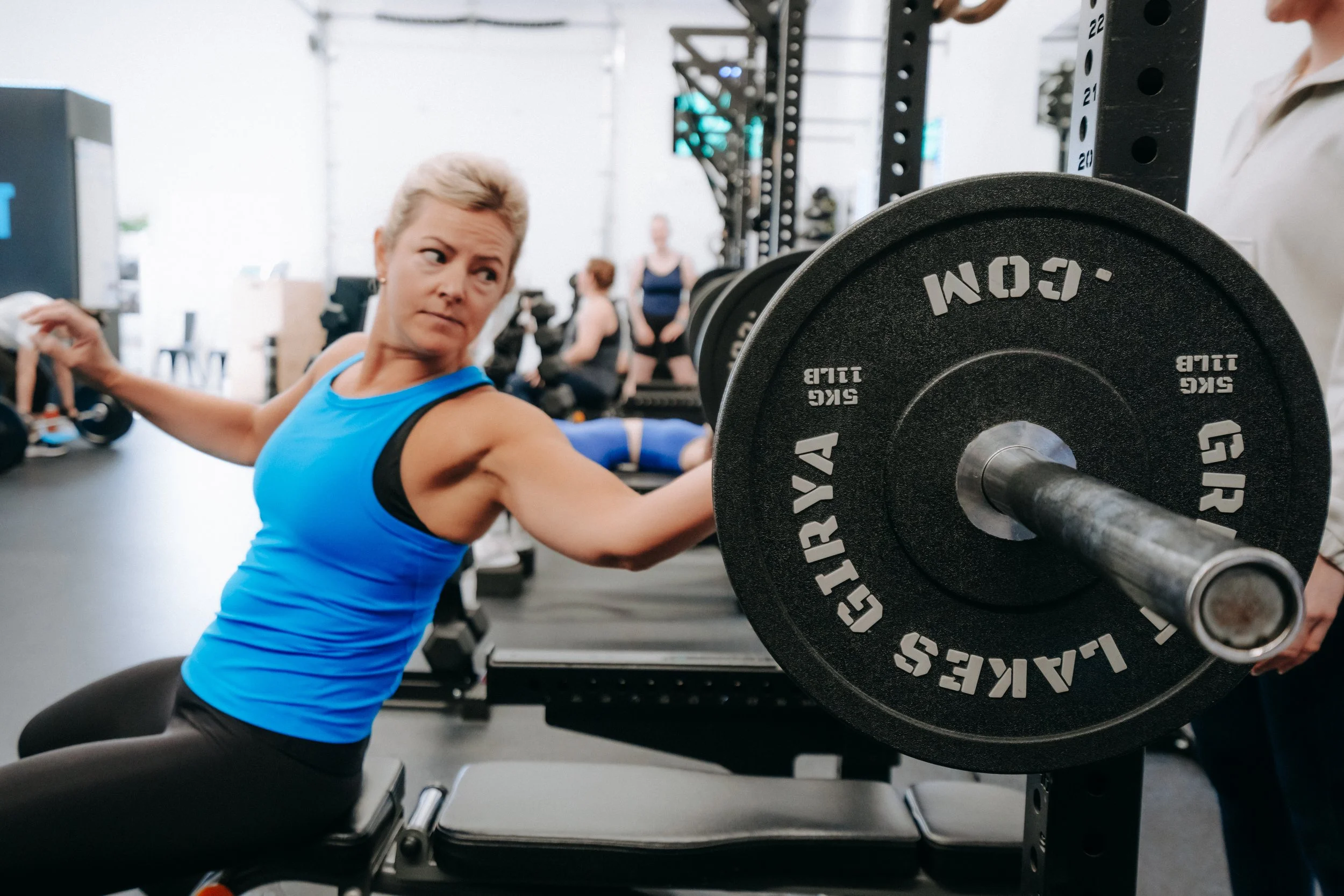
If you're a parent shuttling kids to practice around South Huron, a professional running from meeting to meeting, a farming family working long hours, or all of the above, you already know your time is limited. So let's make sure the way you do fitness actually deserves your time of day.
That method is progressive resistance training (PRT). It's the single most reliable tool you have for building a strong, capable, resilient body for the long haul. It's exactly what personal trainers execute at Jolt Fitness in Exeter Ontario.
Showing up to the gym and checking the box, that's step one. But if you want to maximize your efforts and results, then you absolutely have to apply progressive resistance training. This isn't a fad or an opinion, it's science, and has been for decades.
What Is Progressive Resistance Training?
Progressive resistance training is exactly what it sounds like. You challenge your muscles against resistance (bodyweight, dumbbells, barbells, bands) and you progressively increase that challenge over time. More weight. More reps. Better range of motion. Less rest between sets.
Example from personal trainers at Jolt Fitness, Lucan:
Week 1: 3x10 Bodyweight (BW) Squats to 16" target
Week 3: 3x10 BW Squats to 14" target
Week 4: 3x12 BW Squats to 14" target
Week 5: 3x10 Goblet Squats 10# to 14" target
Week 6: 3x12 Goblet Squats 10#
Week 7: 3x10 Goblet Squats 15#
This is one of many ways to apply progressive overload.
The "progressive" part is the whole game. Your body is efficient. It only adapts to a demand you actually place on it. Lift the same weight the same way forever, and your body has no reason to change. Give it a reason, a slightly heavier bar, one more rep than last week, and it responds by getting stronger, denser, and more resilient to meet the demands.
This is a strategy. It's built week by week, not pulled randomly from a workout generator.
Signs your program is not progressive:
Your main movements or program changes all the time
Your 1-2 main lifts of the day should be the same for 4-16 weeks
You're not tracking the weights you use for your main lifts
There's no regard to rest periods or intensity (reps in reserve/RPE)
Programming is for sweat and to "feel the burn" rather than structured progressive overload
Your workouts are focused on a "vibe" or entertainment based
"I worked at and was in gyms across Canada for a decade before opening Jolt Fitness Exeter. One of the major issues I had with coaching was a lack of integrity for progressive overload and resistance training principles. Sometimes, when I was hired, my objective was to fill time and make people sweat and suffer to good music. Rather than build a program that would actually benefit their health, strength and resilience beyond the gym doors. Choose a gym with good programming, not just good marketing." - Siggy, owner of Jolt Fitness
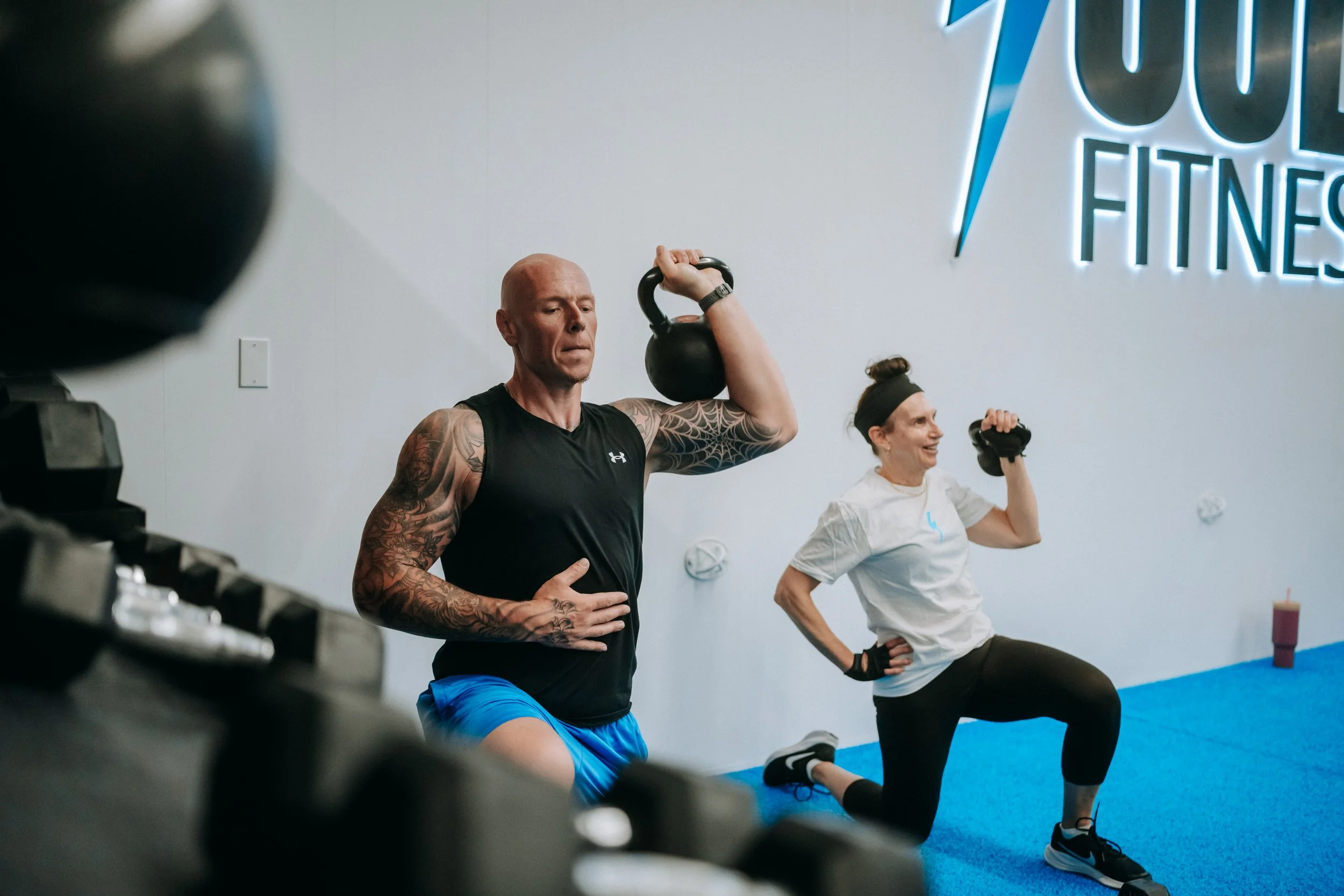
This is one of my favourite photos from our Lift program. This photo is a true demonstration of Progressive Resistance Training is for everyone. It shows how training can be so relative to each individual. I think some people are scared to “lift heavy” or think that they won’t be able to keep up in the program. When really, the program is relative to each individual and resistance training is always customizable to your body. Everyone needs to resistance train with personal trainers at Jolt Fitness, South Huron. - Siggy
Benefits of Progressive Resistance Training
Lifting heavy builds muscle, and that is the investment for everything. Building strength requires load. A landmark review in Current Sports Medicine Reports found that structured resistance training increases lean muscle mass, improves movement control and walking speed, and supports cognitive function. Ten weeks of resistance training can increase lean weight by 1.4 kg and reduce fat weight by 1.8 kg.
It boosts your metabolism, for real. More muscle means your body burns more energy just existing. If you feel like you "gain weight" just looking at pizza, then that's a sign you're probably under muscled. That same research from above found resting metabolic rate can increase by 7% after just ten weeks of resistance training. The stronger you burns more calories sitting at your desk, sleeping, and living your life. Not just during your workout.
It builds resilience against chronic pain. If you've been told to avoid lifting because of back pain, we need to talk. A 2025 systematic review and meta-analysis on resistance training for chronic non-specific low back pain found significant improvements in pain intensity, quality of life, and disability in people who trained with resistance. Pain intensity dropped substantially, quality of life improved, and disability scores improved dramatically. Strength is not the enemy of a healthy back. Coached, progressive loading is the fix. Consider resistance training like medicine, you need to find the right dose for you. Too much, too intense, or the wrong types (of movement patterns), could leave you feeling worse, just like too much medicine. Not enough, and you'll continue to suffer. A personal trainer uses movement testing and progressive overload to help build the right dose of exercise for you.
It reshapes body composition better than cardio alone. If your goal is to build muscle and burn fat, resistance training is the tool built for that job. A major systematic review and meta-analysis on resistance training in healthy adults found meaningful reductions in body fat percentage, fat mass, and visceral fat, the deep, metabolically dangerous fat around your organs (Wewege et al., 2022). Cardio burns calories while you're doing it. Resistance training rebuilds your body so it burns more, all day, every day.
Additionally, we can't target reduce body fat. That means where you lose fat first is largely based on genetics and your diet. More sit ups does not mean less belly fat. But we can target build, resistance training is the tool to sculpt a toned body. A toned, strong and healthy looking body is the result of progressive resistance training and a healthy diet.
It's a legitimate mental health tool. Training works your mind as much as your body. A systematic review and meta-analysis found resistance training meaningfully improved mental health outcomes for people both with and without diagnosed mental health conditions. Sessions in the studies ranged from eight weeks to twelve months, at just one to three sessions per week. Separate research in older adults found resistance training produced large improvements in both depressive and anxiety symptoms, with even larger effects for people already managing a diagnosed condition (Gordon et al., 2017, 2018) and (Cunha et al., 2024). There’s been many times where my husband tells me to “go workout and come back a better person with a better attitude”, and he’s right, it works. Healthy body = healthy mind, attitude, mood, and decisions.
The 6 Pillars of Movement
Every effective program is built on six foundational movement patterns. Master these and you've built a body that can handle whatever life throws at it.
Squat: sitting down and flexing through the knee
Hinge: picking things up safely and folding back at the hips (your deadlift pattern)
Lunge: single-leg strength for stairs, sports, and staying steady on your feet
Push: pressing things away from you
Pull: pulling things toward you
Core: the stability system that ties every other pattern together
Group Fitness ("Jolt Fitness Lift"): Balances these pillars across three-month training blocks to ensure well-rounded, long-term progress without plateaus or injury.
Personal Training: Starts with a comprehensive mobility, cardiovascular, and movement assessment. We pinpoint your specific structural needs such as posterior chain strength, core stability, or single-leg work to tailor every exercise variation, movement angle, and piece of equipment specifically to your body.
Progressive Resistance Training Myths
Myth: "Lifting is bad for my back, or my body." It's not the load that hurts you. It's a lack of mobility or capacity to handle the load. A body that's never been asked to hinge, squat, or carry weight is a body that's unprepared for real life. The fix for a weak, cranky back or knees isn't avoidance. It's progressive, coached strength work that rebuilds capacity.
Myth: "If I'm not sweating and sore, it's not working." Muscle is built through progressive tension over time, tracked in the load on the bar, the reps you complete, and how your movement improves week over week. A brutal sweat session can leave you feeling accomplished without ever asking your muscles to adapt. We coach to the numbers, not just the feeling in the moment.
Myth: "I started lifting and gained weight. Something's wrong." Nothing is wrong. This is often a sign it's working. Muscle is denser than fat. As your body composition shifts (more muscle, less fat) the number on the scale can hold steady or even tick up while your jeans fit better and your energy climbs. That's the goal. More muscle mass and a lower body fat percentage is the healthiest direction your body composition can move, and resistance training is the only tool that reliably builds that muscle. Don't let the scale steal a win that's already showing up everywhere else.
Why Progressive Resistance Beats Walking, Pilates, and Circuit Training Alone
We love a walk. We respect Pilates. Circuit classes have their place. But if your goal is lasting strength, a resilient metabolism, and a body that holds up under real life, the evidence points toward structured, progressive resistance training.
“The saying ‘all movement is good movement’ is true, and I still stand by it. If taking 5,000 steps a day gets you off the couch, or if a Pilates class brings you joy, that has health value. Any step toward moving more is worth celebrating.
However, if we’re honest about achieving long-term health and resiliency, gentle movement alone often isn't enough. Real physical transformation requires deliberate, progressive effort. As Coach Charlie (who previously personally navigated life at over 300 pounds) reminds us: ‘Pushing yourself in the gym is uncomfortable, but living in a body that feels limited and exhausted every day is far harder.’
All movement matters, but effective strength requires realistic expectations. True resilience means embracing the unglamorous side of fitness by showing up consistently, challenging your limits, and picking up heavy things week after week.” -Siggy
Walking is great for cardiovascular health and recovery. It doesn't load your muscles enough to build meaningful strength or trigger the signal your body needs to grow. Pilates builds control, mobility, and core awareness, all valuable, but it isn't designed to progressively overload your muscles the way barbell and dumbbell training is. General circuit training keeps your heart rate up and builds work capacity, but without a clear structure for progressively increasing load, it plateaus fast. Comparative research on aerobic versus resistance training consistently shows resistance training drives significantly greater gains in lean body mass than aerobic-style training alone.
None of these are bad. They just aren't built to do what progressive resistance training does. That's why our programming leads with strength, and layers in conditioning around it.
Your Strategy Starts Here
You don't need a new workout app. You need a coach-guided strategy built around your life, your goals, and where your body is right now.
That's what Personal Training at Jolt Fitness, Exeter is built for. No guessing about whether you're lifting heavy enough, or too heavy, or the right way. Just a non-negotiable, progressive plan, coached by someone in your corner, that turns "I should probably start lifting" into real gains, real resilience, and a legacy of strength you build for yourself and pass on to your kids.
Ready to build your foundation? Reach out to the Jolt Fam and let's build your strategy together.
References
