
The missing piece of postpartum: ribcage mobility
“Postpartum recovery for me felt rushed. I wanted to skip ahead to heavy deadlifts and bench pressing after a couple months of rehab. This left me injured and back to square one. Having my babies basically back to back meant I definitely needed the proper foundation to get me back to where I wanted to be.
I started focusing more on deep belly breathing and nailing the basic principles of how the core functions. This not only helped me build that foundational strength I needed, but it allowed me to connect better to my body. I could actually feel what I needed to do. Coming back to the basics of ribcage and pelvic floor health really helped me advance my knowledge not only for myself, but for all the post natal moms who walk in the gym. This definitely wasn’t easy for me, but looking back I’m so thankful I took the time to do the proper rehab drills.
Take my advice and don’t jump back into your “normal” training regimen. Do the proper rehab, put in the reps, be meticulous, take the time your body deserves. After all, it did take you 9 months+ to grow and birth that tiny human. It’s the least you can do for yourself.” - Coach Bri
When it comes to postpartum recovery we place a high emphasis on closing Diastasis Recti, re-buidling the glutes, and strengthening and relaxing the pelvic floor. We do plenty of deadbugs, bird dogs and glute bridges. But we’re missing something - the ribcage. While everything is just as important as the next, the ribcage tends to get forgotten about.
Let’s find out together as to why this happens and how we can fix it.
SO, HERE’S the problem
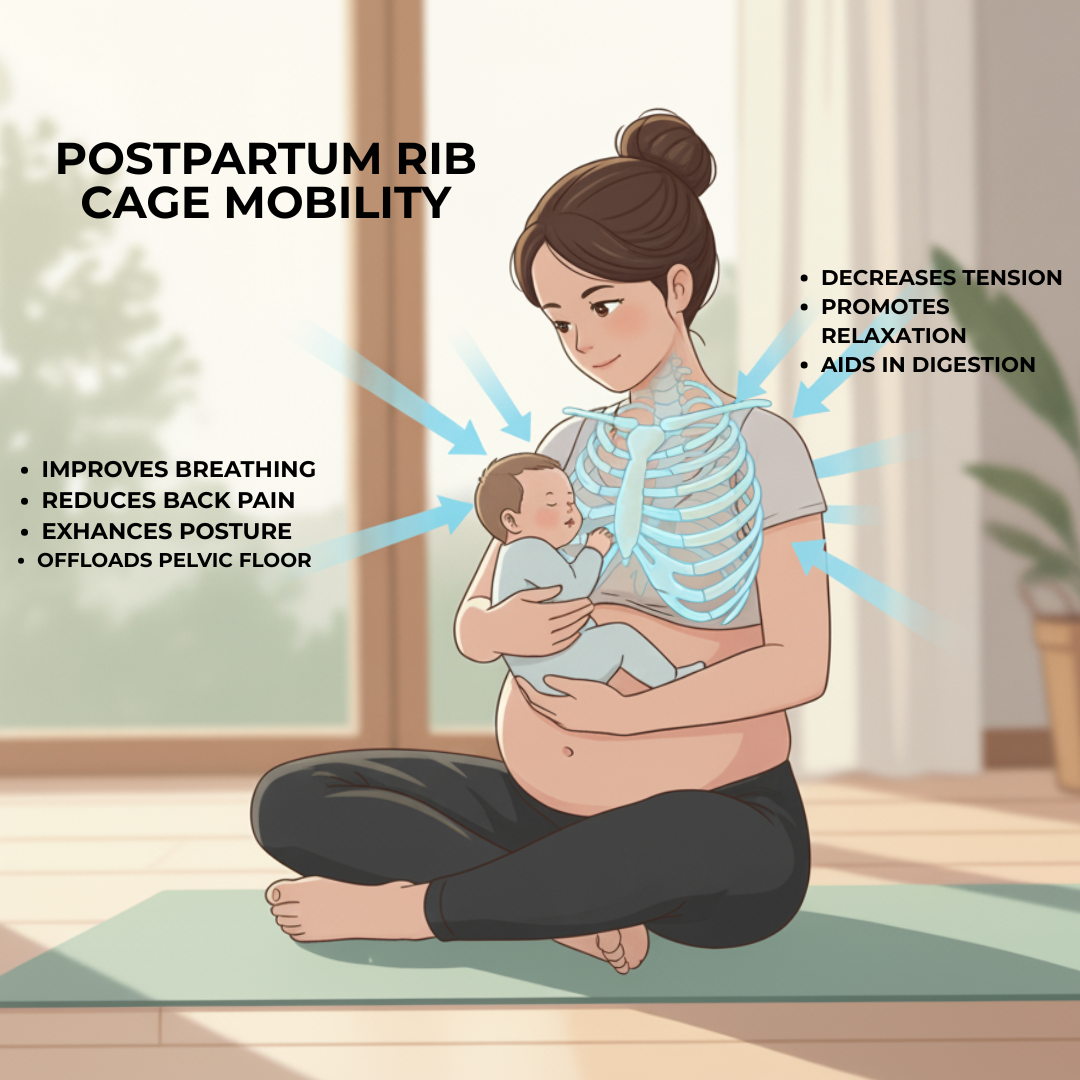
A common postural problem during postpartum is a more shoulder forward position. Let’s call that a “mom hunch”. With the increased time of everything being forward - during pregnancy, feeding your baby, doom scrolling at 3 am, changing your baby, doing the dishes. Quite literally everything we do is with a rounded forward shoulder and upper back. This creates a closed off and compressed ribcage, as well as a weak upper back.
When we close off the ribcage, we compress the lungs, which leads to shallow breathing. This translates into less diaphragmatic breathing and a weak core.
THORACIC MOBILITY & HOW IT TIES INto breathing
Well let’s first talk about thoracic mobility. Our thoracic spine (mid-back) essentially has 3 different movement patterns - flexion/ extension, rotation, and side-bending. The most common use of our t-spine is flexion (rounding forward). When we spend increased time in this position we lose range of motion and strength in the other positions. Pregnancy and postpartum drastically increase our time spent in flexion.
Improving your thoracic mobility isn’t as scary or hard as it sounds. Follow these 3 exercises to help open up your upper back. Complete 1 round per day, the more often you can complete the exercises the more quickly you’ll feel the benefits!
Foam roller extension x10 deep breaths
Side lying thoracic rotation x5/side
Now that we’ve opened up your upper back, it gives us a more upright posture which then allows more space for us to breathe. The diaphragm now has enough room to fully expand and contract. Our diaphragm essentially works like this;
As you inhale it expands like an umbrella 360 degrees, it moves downward, this allows more space in your chest cavity and helps draw air into the lungs
As you exhale the diaphragm contracts and pulls back up with the core and pelvic floor, returning back to it’s natural dome shape to help push air out.
THE UMBRELLA RIBCAGE
This diaphragmatic breathing ties into the lower part of your ribs. The ribs shift slightly outwards and upwards as you breathe in (imagine the ribs shaped like an open umbrella on inhale and a closed umbrella on exhale). When we take shallow breaths up into the chest, the ribcage doesn’t get to move which overtime leads to stiffness in the ribcage (the umbrella gets jammed!). This prevents the diaphragm from being able to expand outwards (open umbrella). Rather, the diaphragm only has room to move downwards placing extra pressure on the pelvic floor. This extra downward pressure could lead to more pelvic floor symptoms like pain, incontinence, heaviness and prolapse.
THE RIBCAGE DURING PREGNANCY
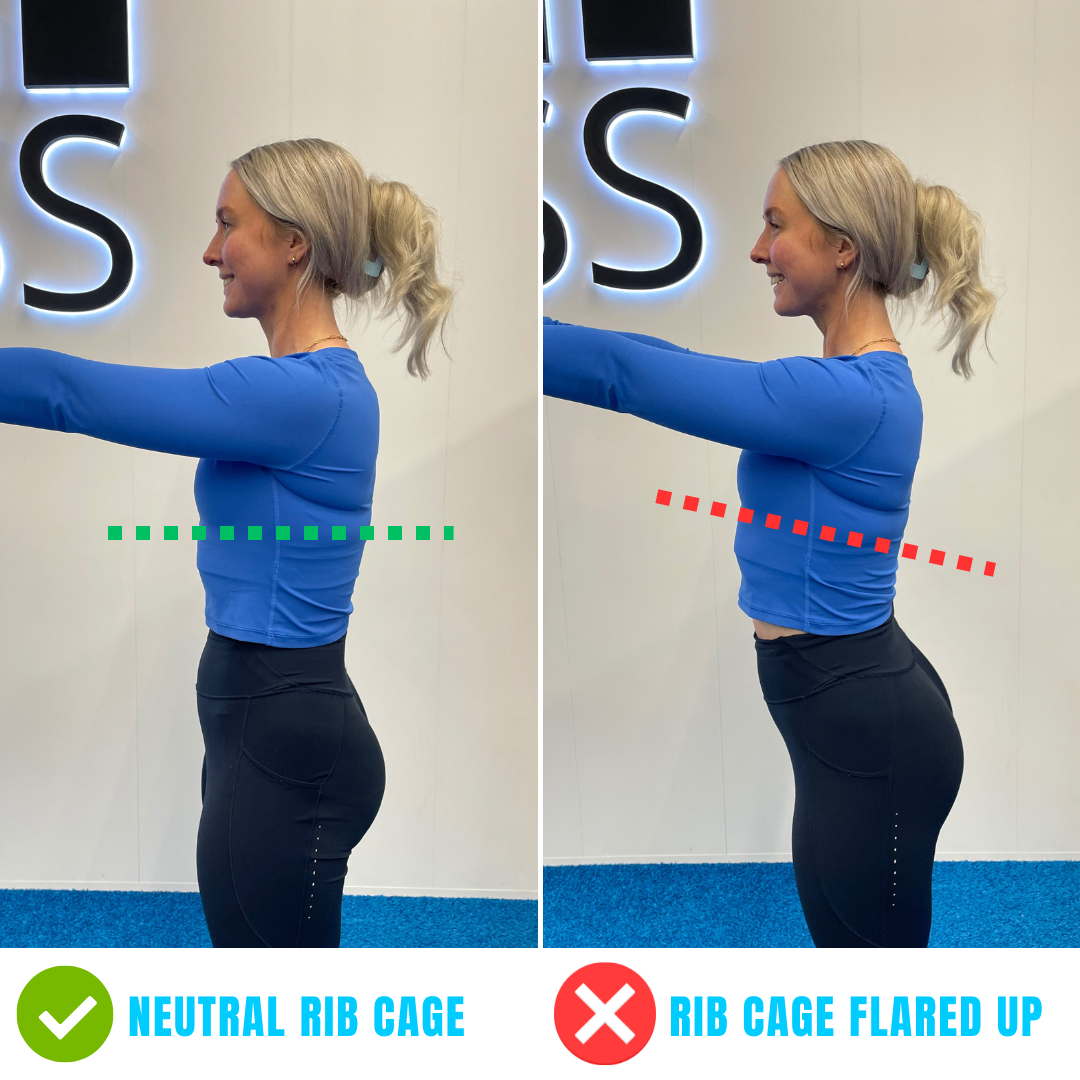
During pregnancy our ribcage expands and moves in order to make space for the growing baby. This often looks like “rib flare”. This is normal for most women postpartum. It’s often linked to core weaknesses, postural and breathing changes.
The good news is, it can be quite simple to address. When we focus on full inhales and exhales, drawing the ribs up and in, and reconnecting with the core. It decreases the flaring of the ribs.
2. WHY IS THIS CRUCIAL FOR POSTPARTUM HEALING?
When postpartum women come into the gym there are usually a handful of the same problems we typically hear.
“I’m leaking when I laugh” “I feel heaviness in my pelvic floor” "I have separation in my abs" "My neck and upper back are constantly sore"
These are all a “normal” part of postpartum. What’s not normal is living with these symptoms and not doing anything about it.
POP CAN CORE
I want you to envision your core like a sealed can of pop, the “core canister”. It includes the diaphragm (the top of the can), pelvic floor (bottom of the can), and abdominals (can walls). These muscles work together as a 360-degree cylinder of pressure to stabilize the spine and manage the pressure inside your abdomen during any movement. If any part of the can has a “hole” in it, it will leak! For example, if the ribcage is “locked” then the top of the can, the diaphragm is dysfunctional leading to pressure issues within the can. This can result in hip/back pain, incontinence, heaviness, prolapse and other pelvic floor symptoms.
3. what do we do to fix this?
Rib expansive breathing
Focusing on getting the lower ribs to move by taking full inhales and exhales is the first step. Now this isn’t always the easiest thing to tap into. Since we’re so used to taking shallow breaths from pregnancy, having some tactile feedback to tell our body where to move can be helpful. Side lying rib expansive breathing with a yoga block is a great way to start.
Engage the deep core muscles
Breathing into the back of your body can help engage the deep core muscles we often forget about. By breathing into the back of the body, we create more room for the diaphragm to expand - rather then just sending the pressure down onto the pelvic floor. When we know how to control these deep abdominal muscles under a small load like our breathe, it makes it much easier to apply that strength when we start adding load to the body. Slowly building connection and consistency with these 2 deep breathing exercises is the starting point. We must first lay the foundational strength before we progress into more dynamic movements.
Being mindful of everyday movement
Continue to build awareness in your everyday positions with this new found movement. When you feed your baby try not to slouch forward. Sit more upright, keep the shoulders retracted down and back, use pillows or blankets as support to stay in these positions.
Check in on rib position when you’re carrying baby, standing, reaching over head, squatting down, etc. Are you ribs flared up and out? Or are they sitting in and down? Try to think about your “stack”. Shoulders over hips, ribs tucked in and down.
Engage your umbrella breathing to fully expand the diaphragm in all directions and work the deep lying core muscles.
Remember that postpartum recovery is not a sprint, it's a marathon. these small actions take time and consistency to build. Thoracic and ribcage mobility are your starting points. The ribcage is your bridge to proper breathing and core strength.
Ready to start your journey? We’re ready too! Our 4 week Post Natal program lays the foundations and teaches you core stability drills, reverses postural deficits after pregnancy, strengthen the glutes, optimizes pelvic floor function and eases chronic pain from repetitive tasks like sitting with, feeding, and carrying the baby.
This is offered online or in-person. You can find more information here and our next in-person program.
-Coach Bri, Post Natal Rehab and Fitness Specialist